
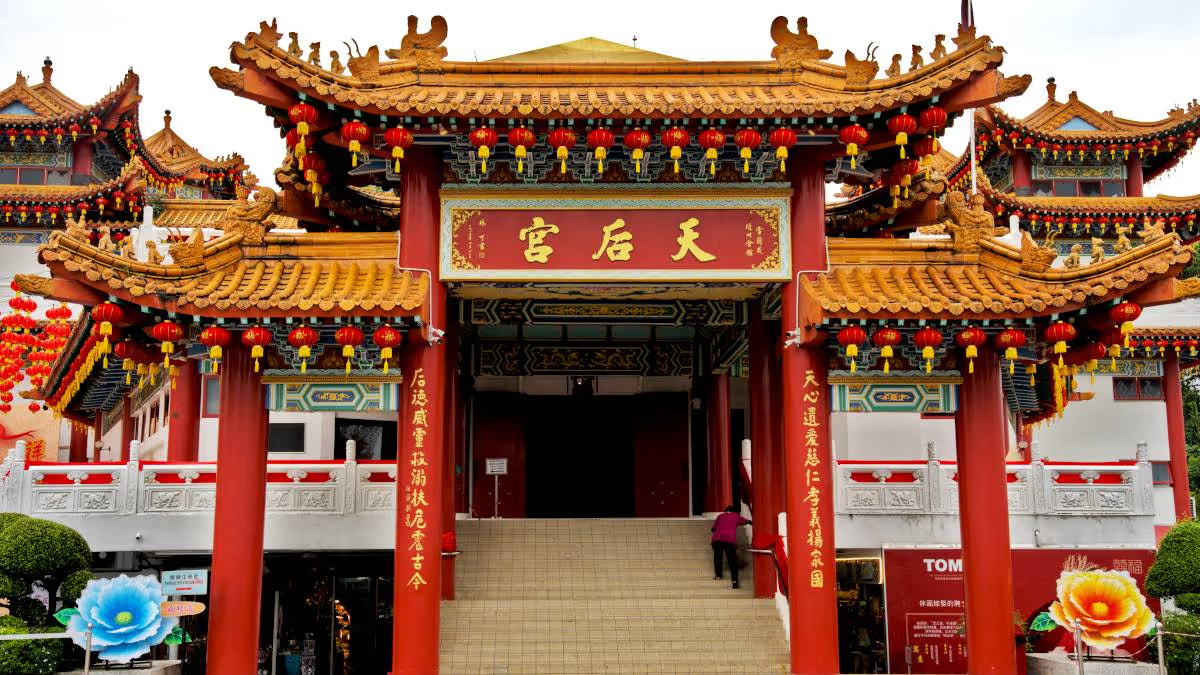
Thean Hou Temple sits on Robson Hill above the Federal Highway, six red-lacquered tiers visible from the city below, but requiring a deliberate climb to reach. The reward is a working Taoist-Buddhist-Confucian complex with panoramic KL skyline views, year-round lantern canopies, a marriage registry, and a trilingual medicinal herb garden that most visitors walk straight past.
The complex is compact, the farthest zones sit about 100 metres apart, but it spans multiple levels connected by stairs. No elevators exist, so factor that in if mobility is a concern.
Key zones:
Photography is welcome throughout, but don't photograph worshippers during prayer. Dress modestly (shoulders and knees covered); free sarongs are available at the entrance. The temple loans them at the counter, return before you leave.
The atmosphere is an active place of worship, not a museum. Expect incense smoke and a reverent mood.
Entry is free across all zones, prayer halls, gardens, upper terraces, everything. Donations are accepted via boxes near the altars and by QR code. No advance booking, no timed entry, no sell-out risk. This policy has been confirmed consistently across 2024–2026 sources.
Official hours are 8:00 AM–8:00 PM daily, including public holidays, effective 1 January 2024. During major festivals (Chinese New Year, Mid-Autumn Festival, Vesak Day), hours sometimes extend informally past 8:00 PM for lantern viewing. One older source mentioned a Monday closure for maintenance, that conflicts with current daily-hours confirmation, but if you're visiting on a Monday, call ahead on +60 3 2274 7088.
Peak congestion runs 10:00 AM–12:00 PM and 4:00–6:00 PM daily. Tour buses begin arriving by 9:00 AM.
The nearest LRT station is Bangsar on the Kelana Jaya Line, 1.4 km from the temple, roughly a 15–20-minute walk with a steep final few hundred metres. Most rail users take a taxi or e-hailing from the station rather than walk uphill in the heat.
Bus routes 710, 770, P701, and T850 serve the vicinity (Moovit data, July 2026). The closest stop, Mcoba KL277, is about 550 metres away (an 8-minute walk). Confirm current timetables via RapidKL or Moovit before you go.
Taxis drop off at the parking area outside the main gates. Fare is metered, no published fixed rate. Confirm your pickup point on the return journey, as the exact taxi zone is not signposted.
Set your destination to "Thean Hou Temple", drivers know it. Drop-off is at the parking area, same as taxis. During Chinese New Year and Mid-Autumn Festival, road congestion backs up the entire hill road; e-hailing drivers routinely decline temple pickups during peak festival periods. If this happens, walk downhill to a clearer street and request from there.
On-site parking is ample, the lot accommodates tour buses. Rates: free on weekdays; RM 5 per vehicle on weekends (as of 2025–2026 visitor reports). Arrive before 9:00 AM on weekends to secure a space during busy periods.
A private chauffeur delivers door-to-door service, no station walks, no uphill climbs, no parking searches. Pickup point and any name-sign meet are confirmed at booking. For multi-stop cultural days (Thean Hou paired with Batu Caves, Chinatown, or other KL attractions), the vehicle waits or returns on your schedule. MPV options are available for larger groups or oversized luggage; elderly-friendly door-to-door routing eliminates stair approaches from public transport. Pricing is quote on request.
KLIA note: AM-peak adds about 4 minutes; PM-peak is actually the easier direction. Allow a full hour from the airport in any traffic scenario.
Arrive before 8:45 AM on a weekday. Tour buses begin pulling in by 9:00 AM, and the halls fill quickly. The 8:00–8:45 AM window gives you cooler air, quieter prayer halls, and unobstructed skyline shots.
Crowd peaks run 10:00 AM–12:00 PM and 4:00–6:00 PM daily. Weekends from mid-morning onward draw both devotees and tour groups, manageable but noticeably busier than weekdays.
Festival calendar to know:
Weather: Outdoor terraces and gardens are fully exposed. Visitors report temperatures hitting 32°C even in the cooler months. Bring sunscreen, a hat, and water. The main prayer hall and basement food court are sheltered. Wet-season months (March–April and September–November) bring sudden afternoon downpours, early-morning visits sidestep both heat and rain.
Coordinating a packed cultural day, Thean Hou Temple, then Batu Caves, then Chinatown, across KL without backtracking or waiting for e-hailing in festival traffic is genuinely difficult. A private chauffeur removes that friction: one fixed price locked before you fly, flight-tracked pickup, no surge pricing, and no taxi queue at the bottom of a steep hill in tropical heat.
Prime Aces Limousine publishes this guide and offers Corporate Chauffeur Service; Airport Transfer Service and Event Transportation. Whether your party is a small group of family members, elderly guests who need door-to-door certainty, or a corporate team building a full cultural itinerary, the service covers multi-stop routing and MPV options without you managing the logistics.
First-time bookings can access an introductory offer, sign up to claim it (the form carries the details).
Yes, it's one of Southeast Asia's largest Chinese temples, entry is free, and the hilltop location gives some of the best KL skyline views accessible without a paid admission. Budget 45–90 minutes.
Most visitors cover the main hall, gardens, and terraces in 45–60 minutes; add 15–30 minutes if you want to try kau cim fortune-telling or explore the medicinal herb garden.
The temple is about 3 km from KL Sentral, roughly 12 minutes by taxi or e-hailing. Walking takes 20–30 minutes with a steep final climb, so most visitors take a short ride.
Modest clothing covering shoulders and knees is recommended, as the temple is an active place of worship. Free sarongs are available to borrow at the entrance if you need them.
Visit on a weekday and arrive by 8:15 AM, before tour buses begin arriving around 9:00 AM. Avoid weekend midday and major festival dates unless you want the festive atmosphere.
.png)
Corporate travel in Singapore depends on more than arranging a vehicle for an executive, client or visiting delegation. The quality of the service is reflected in how carefully each journey is planned, communicated and managed from pickup to drop-off.
.png)
Getting around Johor Bahru is straightforward when the journey only involves one pickup and one destination. It becomes a different kind of booking once Senai Airport, several stops, meetings across different parts of Johor or a longer journey to Desaru enter the itinerary.
.png)
Booking a chauffeur in Singapore is easy enough. The more useful question is what happens once the journey becomes more demanding: a Changi arrival shifts, several meetings run back-to-back, or an executive's schedule changes halfway through the day.


Fixed rates, 24/7 operations, flight-tracked pickups. PAL handles the ground transportation.


.png)
.png)
.png)
.png)
.png)
.png)
.png)
.png)
.png)